Projective Process Monism
A Geometric Framework for Physics, Measurement, and the Observer
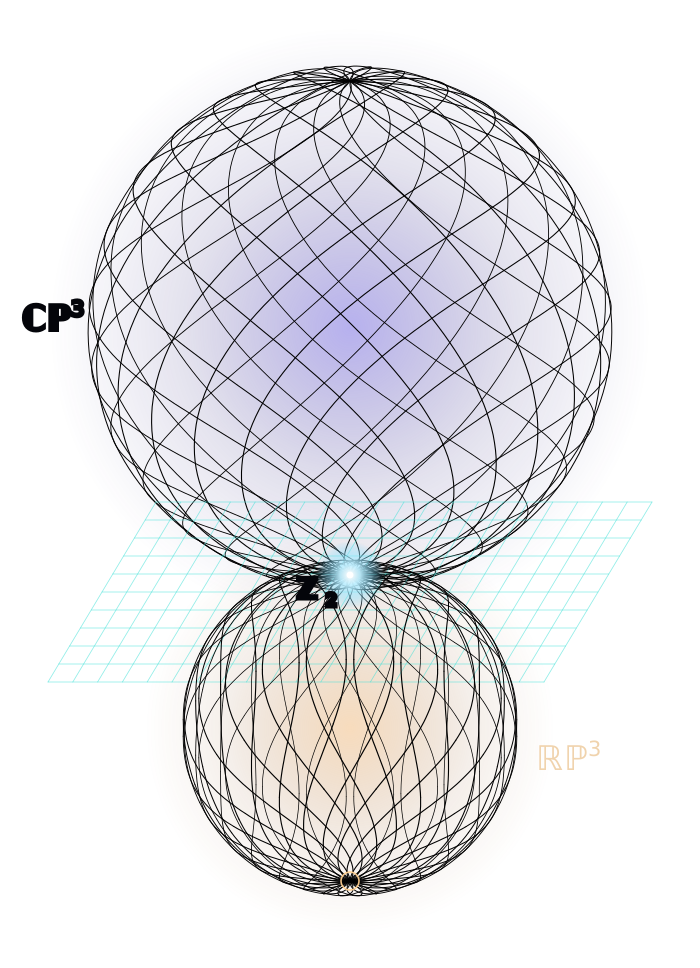
Every current approach to fundamental reality covers physics or experience and goes dark on the other; nothing on the table says what a theory of both would even look like. This project derives that missing shape — the conditions any total theory has to meet, and the form an answer is forced into — before naming a candidate. The derivation asks for a structure that anchors its own description in something nobody has to postulate. Experience is the one candidate, and the orientations an embodied perspective acts within already carry a definite geometry: real projective 3-space. Projective Process Monism follows that geometry to the complex space it is the real locus of, and takes the projection between them seriously as the world's basic operation.
Open argument, openly priced.
The Shape of an Answer
Two short papers, written without reference to any candidate, derive what any total theory must address and what kind of theory could address all of it. The result narrows the field before a candidate ever enters.
The field measured against the standard, and both papers, are on the conditions. What follows is what happens when you take the last row seriously and go looking for the missing mathematics.
Where the Geometry Comes From
A theory that ascribes only abstract structure to the world says almost nothing, because any collection of the right size can be arranged to instantiate it. Something has to tie the structure to reality, and every standard way of supplying that tie pays a known price. Experience is the one candidate nobody has to postulate: it is the single piece of the world each of us occupies rather than describes.
That is where the geometry enters, and the specificity is the point. The orientations an embodied perspective acts within form real projective 3-space, ℝℙ³ — and its fundamental group is two-valued, the structure the belt trick demonstrates by hand and a neutron interferometer registers as a phase reversal in matter. Withhold the identification and the two structures still match; what you give up is the claim that they are one.
The argument is made in full on the anchor page; the space itself is walkable on The Road Behind.
One Structure
Ask what complex space has ℝℙ³ as its real locus and the answer is ℂℙ³, complex projective 3-space, whose complex conjugation τ fixes exactly that set. Possibility is ℂℙ³; actuality is ℝℙ³; measurement is the process that settles the first onto the locus τ fixes.
That is the whole premise. One geometric structure, reached by following the anchor rather than posited in front of it.
Both panels build the same space, by different routes, and both are drawn exactly.